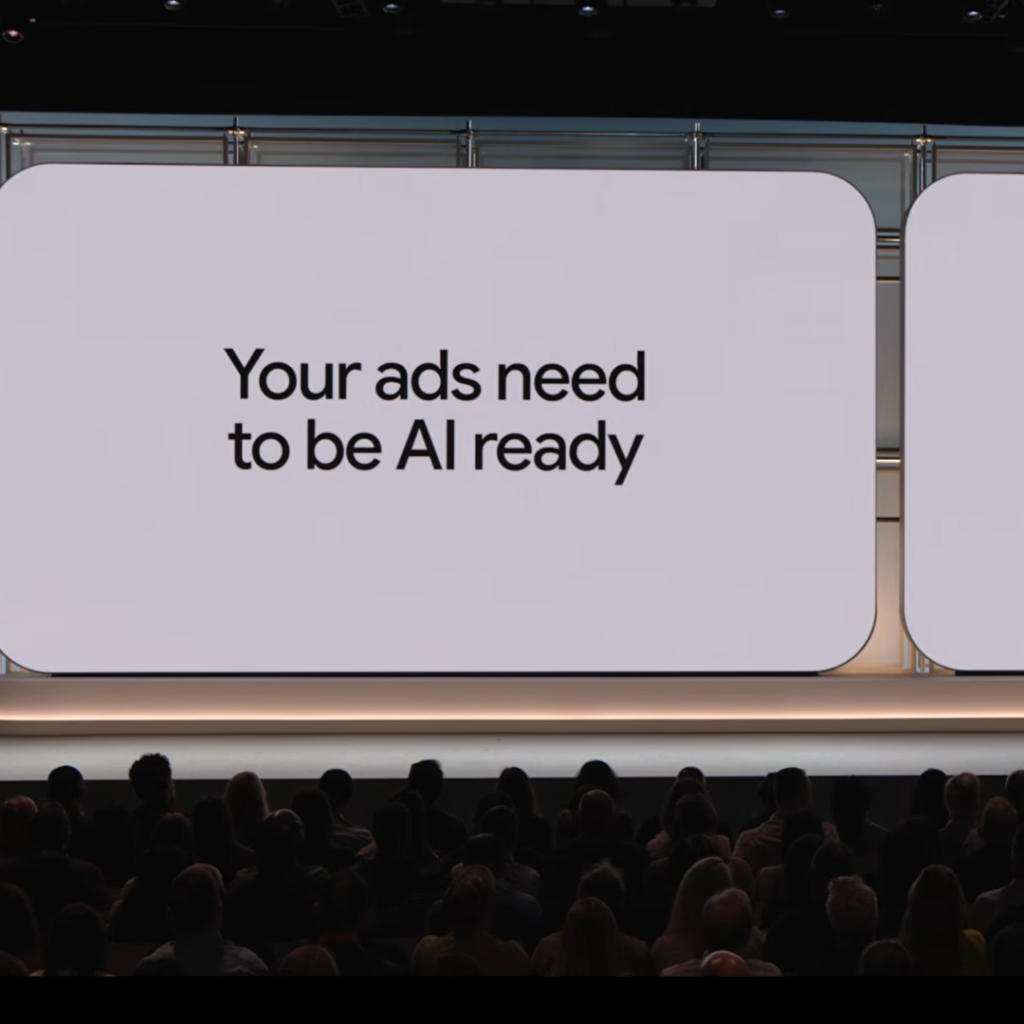
Every year, Google Marketing Live is the clearest signal of where Google is placing its next bet. This year there was no ambiguity: the era of keyword centric, manually optimized Google Ads is over. The era of AI mediated intent discovery has begun.
The five pillars announced at Google Marketing Live 2026 represent a coherent strategy. Google is no longer positioning itself as an advertising platform. It is positioning itself as the infrastructure layer between brands and consumers across every stage of the purchase journey.
For performance agencies, this is either a threat or an opportunity. That outcome depends entirely on how quickly you understand the new rules.

Five things Google changed at GML 2026.
One event from Google Marketing Live 2026. Five structural shifts. Here is what each one means in practice.
AI Max is not a new campaign type. It is a feature layer applied to existing Search campaigns that uses Gemini to match your ads to a broader range of queries based on semantic intent, not exact keyword matches. It also introduces AI Brief: a natural language field where you describe your strategy to the AI in plain English.
The uncomfortable truth for search practitioners: if AI Max is matching your ads to queries you never bid on, your keyword list is no longer your targeting instrument. Your campaign objective, your landing page and your AI Brief are.
Auditing all active Search campaigns for AI Brief readiness and restructuring keyword architecture around intent clusters. Piloting AI Max on mid funnel campaigns for our eCommerce and D2C clients where intent diversity is highest.
Demand Gen now reads signals from Search, Maps and YouTube simultaneously to identify users in the pre search phase of a purchase journey and serve them your content before they have articulated the intent. Most YouTube advertising is still being run as an awareness play. Demand Gen is designed to generate demand that converts, not just demand that exists.
The addition that matters most: Demand Gen now accepts creator assets as ad inputs and connects YouTube exposure directly to downstream conversions via Maps and Product Feed surfaces. For brands already running Partnership Ads on Meta, the implication is direct: the creator led conversion model now has a YouTube equivalent with Google identity graph attribution behind it.
Migrating relevant Discovery campaigns to Demand Gen and testing creator produced video assets as inputs. Building Demand Gen as the mid funnel complement to Search: YouTube generates demand, Search captures it.
With Agentic Commerce and the Universal Commerce Protocol, shoppers can now research, compare and buy inside a Gemini or AI Mode conversation without ever visiting a website. The store goes to the consumer.
Google’s message at the event was direct: rich Merchant Center feeds are the mandatory bedrock of discovery and trust. If your product data is incomplete or outdated, you are invisible in Agentic Commerce flows. Merchant Center has historically been treated as a technical requirement. That framing is now wrong. It is your storefront inside the fastest growing shopping surface Google has ever built.
Running full Merchant Center audits for all eCommerce clients and prioritizing AI Max for Shopping activation for those with clean, well structured feeds.
Asset Studio lives inside Google Ads, connects to your campaigns directly and uses Google’s multimodal AI models to generate high variety assets at the quality level the platform rewards. It supports third party platform connections and one click creative testing. Creative hypotheses that used to take days to test can now be validated in hours, inside the same interface where the campaign runs.
Integrating Asset Studio into our creative review workflow for variation testing. AI generated variants are hypothesis validators. Human strategic direction stays at the brief and selection stage.
Google is converging three historically separate systems: Google Analytics for behavioral data, Data Manager for first party data infrastructure and Meridian for Media Mix Modeling. The result does not just report what happened. It establishes causality, controls for external variables and feeds signals back into campaign AI for better optimization.
The prerequisite for all of this is Google Tag Gateway: server side tagging that ensures first party data collection survives browser restrictions and signal degradation.
Recommending Google Tag Gateway migration for all clients still on client side tagging. Building Data Manager integration into our onboarding standard. Piloting Meridian as the primary cross channel measurement framework for clients managing above $15K per month in media spend.
What Google’s AI era actually means for agencies.
Every major Google announcement over the past three years has automated something an agency used to do manually. So what is left?
AI Max automates keyword matching. Asset Studio automates creative generation. Performance Max automates placement and bidding. The question is legitimate: what does a performance agency do when Google handles execution?
The answer is that the question misframes the situation. What Google is automating is the execution layer. What it cannot automate is the strategy layer above it, and that layer is becoming more valuable, not less.
“Google is automating execution. The agencies that understand this are doubling down on strategy, data infrastructure and creative direction. The agencies that do not are competing with a button.”
At KINAI, this is how we have always positioned the practice: AI powered performance, led by people. GML 2026 validates that framing. The tools are more powerful than ever. The strategic layer that operates them is more differentiated than ever.
Quick answers for your team.
Ready to build for Google’s AI first era?
We run paid media strategy and implementation for brands across Google, Meta and programmatic channels. Write to us and we will take it from there.
Get in touch →