
“We invested in content creators. Awareness went up. Sales did not move.”
One of the most consistent frustrations we hear from brand owners and CMOs — at strategy sessions, at industry events, in first conversations with new clients — is some version of this. It is not an isolated complaint. It is structural. And it is one we have seen resolved, consistently, when the right system is built around the creator through Partnership Ads.
The Way Creator Marketing Was Built Before Partnership Ads
For most brands, content creators and paid media have always operated as separate budget lines with separate objectives. Creators build awareness. Paid media drives conversions. The two rarely connect.
In practice, a creator publishes content, engagement spikes briefly, and then the post disappears into the feed. No conversion optimisation. No distribution control. No system behind the content to capture the commercial intent it generated.
Meanwhile, the brand runs performance campaigns from its own account. Product visuals. Feature callouts. Direct offers. Efficient, but cold.
Two systems. No integration. And when creator investment gets evaluated on revenue but was never structurally built for revenue, the conclusion is predictable. The conclusion is not wrong. The setup is.
What Changes When Partnership Ads Enter the Performance System
Meta’s Partnership Ads and TikTok’s Spark Ads allow brands to amplify a creator’s post as a paid ad while keeping the creator’s identity, handle, and engagement visible. The content feels native. The optimisation runs on conversion objectives.
This means brands can optimise for purchases directly through the creator’s post, track results through Meta’s pixel attribution, and control budget, frequency, and placement — without the content losing its original identity or the creator’s credibility.
The creator stops being a line item in the awareness budget. They become the acquisition layer inside a measurable commercial system. The difference is not the creator. It is the infrastructure the brand builds behind them.
What We Observed Across Two Markets Running Partnership Ads
To evaluate whether this model produces measurably different commercial outcomes, we ran a structured three-month test across two markets — Europe and Asia Pacific — for a luxury jewellery client with products priced between $5,000 and $12,000.
The objective was direct: compare a creator-led Partnership Ad against standard performance ads built around product visuals. Both campaigns ran under broad targeting, allowing Meta’s delivery system to optimise toward buyers without manual audience restrictions. Budgets were comparable. Landing pages were identical. Pricing, funnel structure, and attribution windows were standardised across both.
The only variable was creative identity and delivery format. The creator-led ad ran from the creator’s handle in partnership with the brand. Product ads ran from the brand account alone.
Across the AU market from July to September 2025, the creator-led Partnership Ad delivered 92 purchases at a cost per purchase of $8.74, generating $318,583 in tracked purchase value at a 396 ROAS — with a total spend of just $804. The two standard product ads — a jewellery video and a product-specific creative — combined for 52 purchases at ROAS of 344 and 294, with higher costs per purchase of $9.17 and $10.41 respectively.
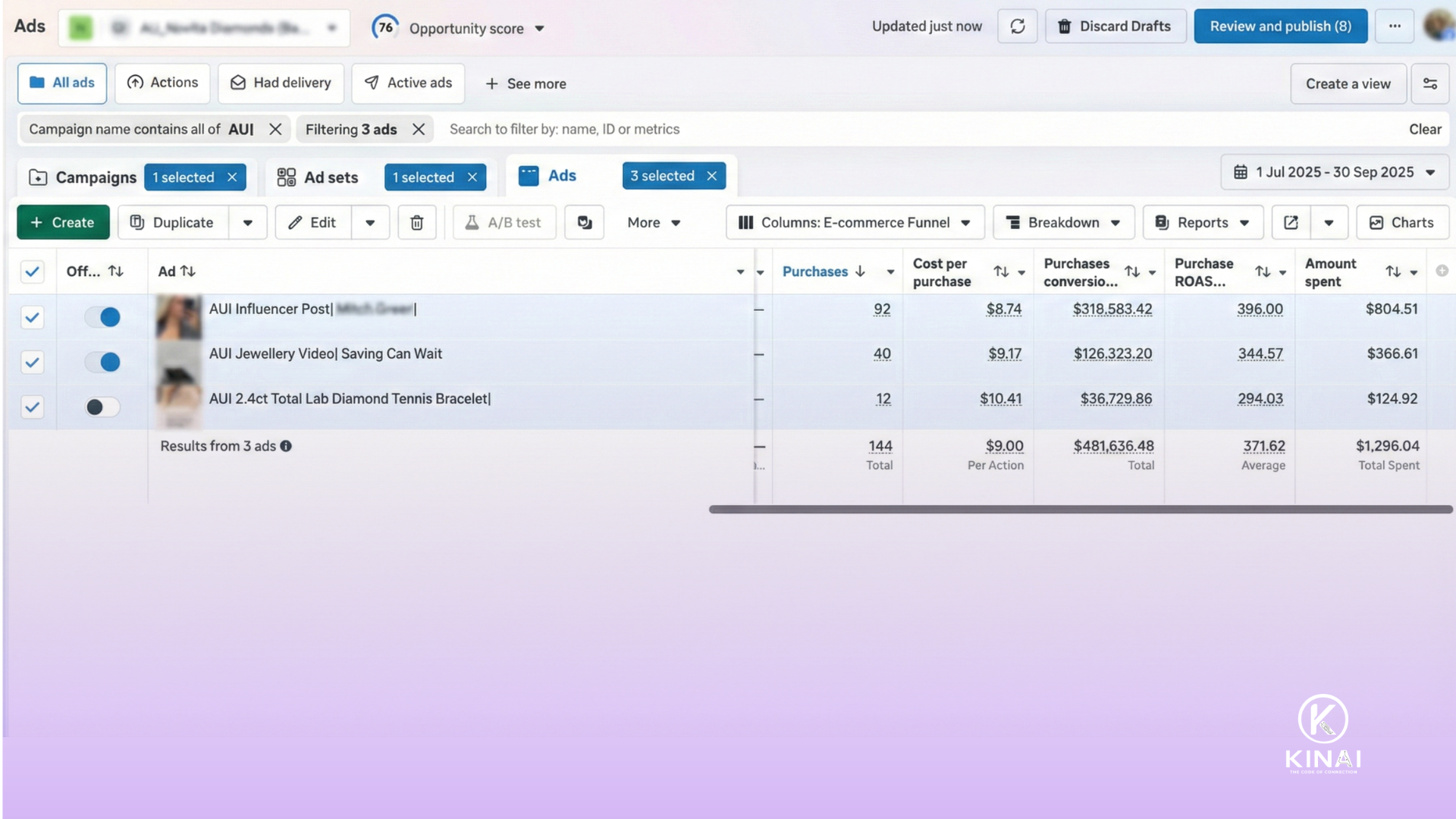
In high-ticket categories, order value naturally amplifies performance differences. What validated the model was not the ROAS figure alone. It was the gap holding consistently between the creator-led Partnership Ad and the two standard product ads — same offer, same funnel, same period. Different creative identity and commercial infrastructure.
Why the Economics Shifted with Partnership Ads
Three dynamics drove the difference.
Creator credibility improved platform delivery. Creator content generated stronger early engagement. In auction-based platforms, engagement signals relevance, and relevance reduces cost pressure. This is not a branding argument. It is how platforms decide where to allocate spend efficiently.
Familiar identity reduced purchase friction. In high-consideration categories where trust materially influences buying decisions, a recognisable creator performs differently than a brand account. The message feels like a recommendation. The transaction does not feel transactional.
Commercial structure converted attention into revenue. High-ticket purchases rarely close on first exposure. The system behind the test used conversion objectives layered with sequential campaign logic. The creator generated qualified attention. The commercial structure was built to capture and convert that intent. Without that structure, the results would have resembled a typical creator activation: strong engagement, weak revenue attribution. This is precisely where Partnership Ads create a structural advantage — they connect creator output directly to a measurable commercial outcome.
What Partnership Ads Do Not Fix
Creator-led performance is not a solution for weak commercial foundations. If product-market fit is unclear, if the landing page experience is poor, if checkout friction is high, or if pricing is misaligned with the market, no creative format will correct that.
When fundamentals are broken, amplification accelerates the problem. When foundations are solid, this model becomes a multiplier. External research on creator campaign ROI by Nielsen found that brands are historically operating at just 25% of their creator investment potential — and that optimising weekly paid media weight can increase ROAS by approximately 20%. The commercial infrastructure is the multiplier. The creator is the input.
What Most Brands Are Missing Before They Invest in Partnership Ads
The brands that see strong results from this model share one thing in common. They treated it as a commercial decision before they treated it as a creative one.
That means evaluating whether the brand infrastructure is structured to convert creator attention into revenue before increasing spend. It means ensuring creator partnerships are commercially structured, not just creatively aligned. It means validating that the platform setup, the content design, and the amplification budget are each serving a distinct commercial function.
Most brands that have invested in Partnership Ads and seen weak returns were not dealing with a creator problem. The content was often strong. What was missing was the commercial layer connecting creator output to business performance.
Before we recommend this model to any client, we run a structured pre-investment checklist to assess whether the brand is commercially ready to convert creator attention into measurable revenue. We have made that checklist available here.
If several items are unclear after completing it, the priority is structural before it is creative.
Free resource · 5 minutes
Is Your Brand Structured to Turn Creator Content into Revenue?
The internal checklist we run at KINAI before recommending any investment in creator-led Partnership Ads. Five areas. Fifteen points. One clear picture.
Access the Checklist →